Beat Modules Brings AI Simulations to PSHE Education: Measuring Real-World Decision-Making Skills Over Time
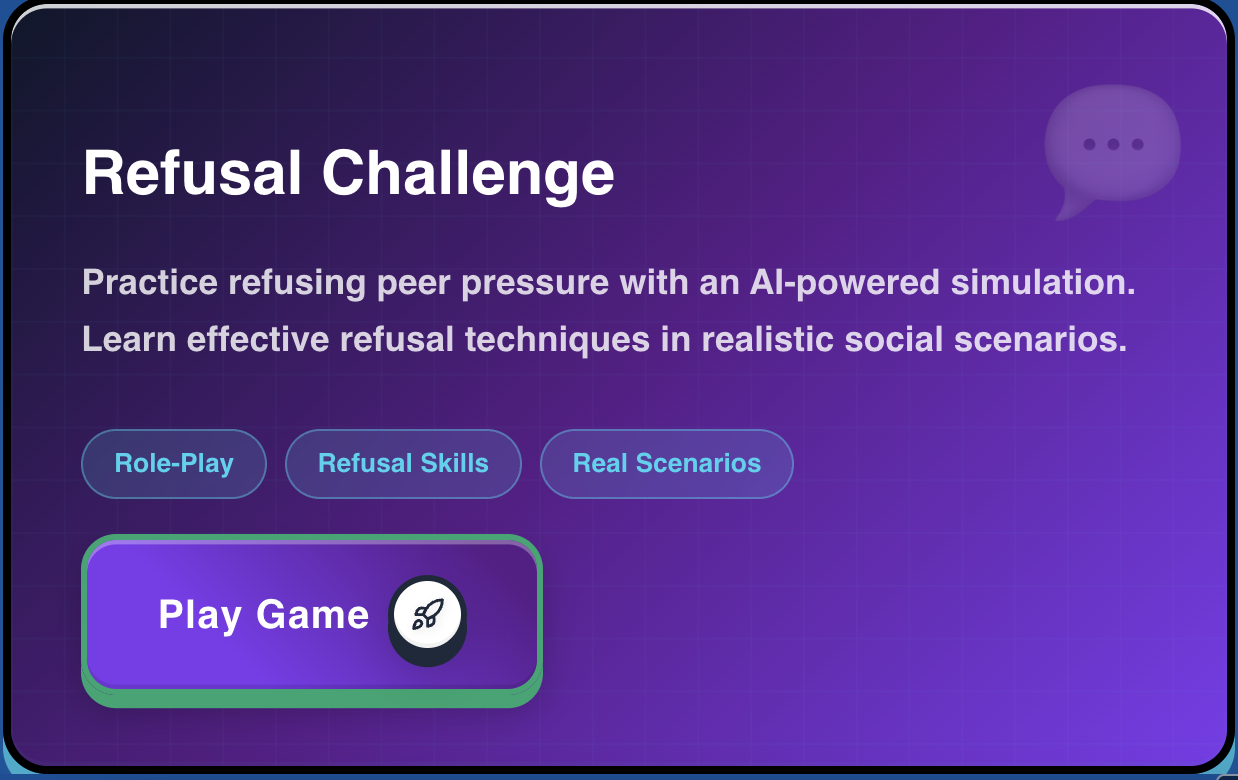
The challenge with traditional PSHE (Personal, Social, Health, and Economic) education is rarely a lack of information. Most students already know they are expected to “set boundaries” or “avoid peer pressure.” The difficulty lies in translating that knowledge into action - especially in real social settings, under time pressure, and in front of peers.
At BeatModules, we use AI-driven role play to address this gap. Rather than assessing whether students can identify the “right” answer, our system focuses on behavioural practice. It creates simulated social situations where students can rehearse difficult conversations and decisions in real time, helping them build practical confidence for situations they are likely to encounter.
Practice Without Social Exposure
In-class role play can be effective, but it also introduces barriers. Many students feel uncomfortable acting in front of peers, which can lead to superficial participation or avoidance altogether.
Our approach removes that social exposure. Students interact privately with AI-generated scenarios, allowing them to try different responses, make mistakes, and adjust their approach without fear of embarrassment or real-world consequences. Scenarios can be repeated and gradually intensified across different contexts - for example, moving from a low-pressure social setting to a more crowded or high-stakes one.
Research on group dynamics shows that people often withhold concerns or remain passive when they perceive interpersonal risk. By removing that risk, we enable more honest engagement and more meaningful practice.
Measuring Skill Development
Many PSHE programmes rely on self-report surveys to evaluate impact. While useful, these measures often capture intentions or awareness rather than practical capability.
Our platform instead tracks behaviour within the simulations. We observe how students respond as pressure increases, which strategies they use to maintain boundaries, and how consistently they apply those strategies across scenarios. This allows schools and partners to see evidence of skill development over time, rather than relying solely on stated attitudes or knowledge recall.
A Flexible Framework for Life Skills
Although our initial modules focus on vaping and peer pressure, the underlying system is designed to be adaptable. The same structure can support practice in a wide range of situations that involve social judgement and decision-making, including:
Social conflict and bullying
Consent and healthy relationships
Online safety and digital behaviour
Navigating risky or ambiguous social situations
Effective learning often involves engaging with competing pressures and perspectives. Our simulations are designed to expose students to that complexity in a controlled, supportive environment.
Looking Ahead
Improving PSHE outcomes requires more than reinforcing information students already recognise. It requires opportunities to practise applying that knowledge in situations that feel realistic and relevant.
By integrating AI-based simulation into PSHE, BeatModules provides a practical tool that reflects how young people actually communicate and make decisions. Rather than prescribing responses, we focus on helping students develop the confidence and skills to respond effectively in their own way.